
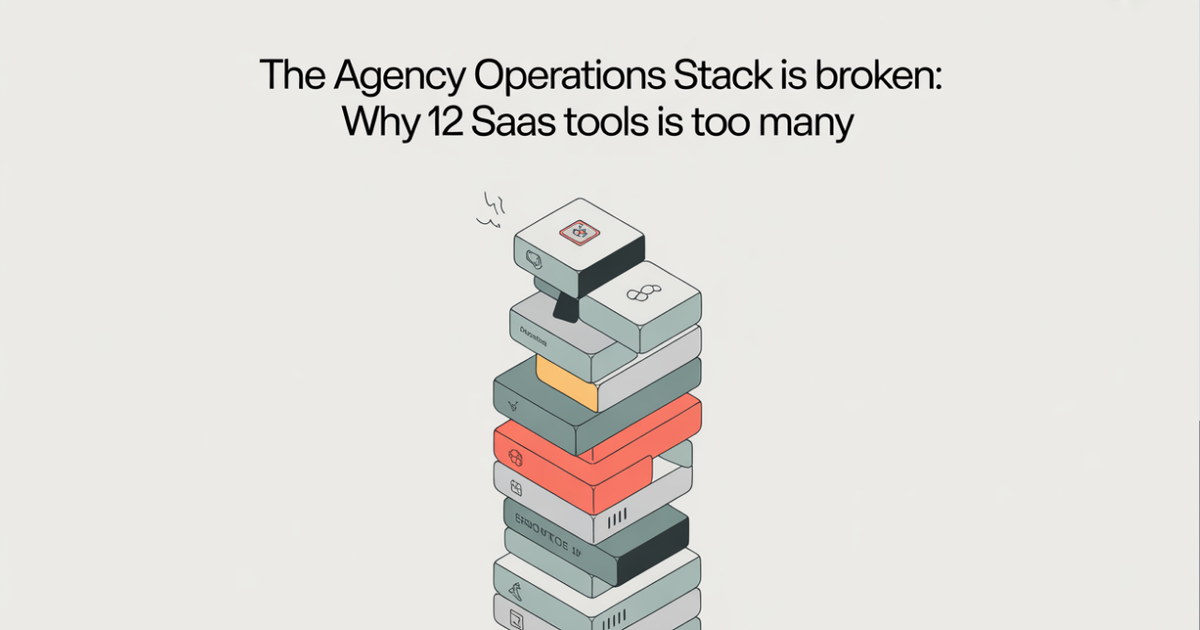
Count the tabs open on your account manager's browser right now. Project management. Client Slack. Google Drive. A reporting tool. The CRM nobody fully adopted. A time tracker that only gets updated on Fridays. An invoicing platform that doesn't talk to any of the others.
That's six tabs. And their actual workday probably involves twelve.
Here's the thing: none of those tools are bad. Most of them are genuinely good at what they do. The problem isn't the tools, it's the stack. When you string together a dozen disconnected platforms to run a single agency, you haven't built a system. You've built a workflow tax that your entire team pays every single day without realising it.
This post lays out exactly what a bloated agency stack costs in real productivity, how it happened to almost every agency (including yours), and what the path to fewer, better tools actually looks like.
How Agencies End Up With 12 Tools in the First Place
Nobody sat down and decided to run their agency on fifteen platforms. It happened incrementally, through perfectly rational individual decisions that produced an irrational collective outcome.
The "good enough at the time" trap
Every tool in your stack was added for a reason. The project management tool replaced spreadsheets. The reporting tool replaced a manual Google Slides process. The AI writing tool replaced three hours of copy drafting. Each addition felt like progress. And it was, briefly.
The problem is that tools compound. Each new platform solves one problem while creating two new ones: it needs to be learned, maintained, integrated (or not), paid for, and context-switched into from whatever the user was doing before. You solve the reporting problem and inherit the login-and-configure problem.
The client-imposed stack layer
Agencies don't just manage their own tools. They manage their clients' tools too. A client insists on Basecamp. Another only communicates through their own Slack workspace. A third has a proprietary reporting portal they want you to update weekly. Before long, your team is context-switching between their internal stack and three or four client-mandated environments on the same day.
Employees switch between tabs, apps, or platforms an average of 33 times per day, with 17% of workers switching more than 100 times in a single workday. DataStax For agency teams juggling both internal and client-facing tooling, that number skews significantly higher.
The "we'll integrate it later" debt
Most agencies have at least two or three tools in their stack that were added with the promise that someone would set up the integration eventually. The Zapier workflow that was supposed to sync the CRM with the project management tool. The reporting dashboard that should auto-pull from the ad platform but still needs a manual export every month. That debt doesn't disappear. It just gets serviced every week by someone doing a job that a connected system would do automatically.
What 12 Tools Actually Costs Your Agency
The license fees are visible. The real cost isn't.
The context switching tax
Research from the American Psychological Association shows that chronic multitasking and frequent context switching can consume up to 40% of a person's productive time. Datastat A team member working eight hours a day in a fragmented tool environment may only be producing the equivalent of five focused hours. The other three are tax, paid in the form of mental reorientation every time they switch platforms.
That math across a team of eight costs you roughly 24 hours of productive capacity per week. Not from laziness. From tooling that forces people to constantly reload context.
The onboarding multiplier
Every tool in your stack multiplies the time it takes to get a new hire operational. One platform might take a day to learn. Twelve takes two weeks, and that's before they've had to navigate the specific quirks of how your agency uses each one, the naming conventions, the folder structures, the unofficial workarounds. Nearly 4 in 5 employees say their company has taken no steps to reduce tool fatigue or consolidate platforms Dataiku , which means the onboarding problem is systematic, not accidental.
The invisible SaaS spend
Research consistently shows companies waste between 17% and 25% of their SaaS spend before they take action to manage it. DatastiQ For a ten-person agency spending $4,000 per month on software, that's $800 to $1,000 per month going to tools that are underused, duplicated, or actively abandoned. Multiplied over a year, that's a junior hire you didn't make.
Nearly 50% of SaaS licences go unused for 90 days or more. datarooms Check your stack against that figure. There's almost certainly a tool in there that someone signed up for during a busy Q4 and hasn't opened since January.
The 12-Tool Stack Is a Symptom, Not the Diagnosis
Cutting your stack from twelve to six doesn't fix the underlying problem. The underlying problem is that your agency is running on generic tools that weren't designed for how your specific operation works. You adapted your processes to fit the tools instead of the other way around.
Why consolidation alone isn't enough
Switching from Asana to ClickUp, or from AgencyAnalytics to Whatagraph, shuffles the deck without changing the game. You still end up with a collection of platforms that each do one thing well and require manual bridges to everything else. The context switches change. The volume doesn't.
What "fewer tools" actually means
Fewer tools doesn't mean fewer features. It means fewer systems. It means client reporting, project tracking, time logging, and invoicing flowing through one environment rather than four , because they're built around the same underlying data rather than bolted together with Zapier. It means your account manager can open one dashboard and see everything relevant to their day, rather than reconstructing a picture from six different sources.
The agencies that have genuinely solved the stack problem haven't found a better SaaS product. They've replaced the parts of the stack where they had the most friction with custom-built internal tools designed around their specific workflows. One reporting system that works exactly how their clients expect. One project view that maps to how they actually staff and deliver work. Zero integrations that someone needs to maintain.
FAQ: Questions Agency Owners Ask About Fixing Their Stack
How do I know which tools to cut first?
Start with the ones your team works around rather than inside. If someone is regularly exporting data from a tool to process it somewhere else, or manually copying information between platforms, that tool is creating more work than it's removing. These are the first candidates for either consolidation or replacement.
Won't cutting tools create gaps in what we can do?
Only if you cut without replacing. The goal isn't to do less — it's to do the same things in fewer places. When you consolidate or replace a cluster of tools with something built specifically for your agency's workflow, you typically end up with more capability in the areas that matter, because the replacement is built around your actual use case rather than a generic one.
What's the difference between consolidating SaaS tools and building something custom?
Consolidating means picking one SaaS platform instead of three. You still adapt your process to fit the tool's logic. Building something custom means starting with your process and building the tool around it. The first approach reduces cost and complexity. The second removes the ceiling on what your operations can do.
How much time does fixing the stack actually save?
It depends on the current stack, but the context switching research gives a useful frame. Employees lose an average of 51 minutes per week to tool fatigue, with 22% losing two or more hours. VC Stack For an eight-person team, recovering even 30 minutes per person per day from a streamlined stack returns 20 hours of capacity per week — without hiring anyone or working longer hours.
The Stack You Have Is the Stack You Designed by Not Deciding
The agencies that scale without hiring at a 1:1 ratio to client growth share one thing: they made deliberate decisions about their operations infrastructure. They didn't let the stack accumulate. They audited it, questioned it, and replaced friction points with systems that actually fit how they work.
Twelve tools isn't a sign that your agency is sophisticated. It's a sign that your operations have outpaced the infrastructure decisions you've made so far. The good news is that's a solvable problem and solving it doesn't require a six-month IT project.
It starts with a clear-eyed look at where your team spends time that isn't client work. That audit usually reveals two or three obvious consolidation points. Those are where the highest-ROI changes happen first.
Want a faster way to run that audit? Take DataStaqAI's free Agency Ops Audit. Answer ten questions about your current stack and delivery workflow, and get a prioritized report showing exactly which tools and processes are costing you the most.