
Your agency is running its entire new business operation on a tool built for a SaaS startup with 15 SDRs and a VP of Sales.
That's what HubSpot or Salesforce is. Built for product companies with linear sales cycles, fixed pricing, and a clear distinction between leads, opportunities, and closed customers.
Your agency has retainers that renew in 90 days. Clients who buy one service and could be upsold on three more. Relationships that go quiet for six months and then reactivate. Referrals that come in with no pipeline stage to put them in. Project kick-offs that happen before the contract is even signed.
Between 20% and 70% of CRM implementations fail to achieve their planned objectives DataStax and the failure rate for agencies specifically is almost certainly at the higher end of that range, because most agencies try to use tools designed for a fundamentally different sales motion.
This post is about what a CRM built specifically for your agency actually looks like, what it does differently from off-the-shelf options, and the practical path to getting one without a six-figure development project.
Why Generic CRMs Break Down for Agencies
The HubSpot vs Salesforce debate is worth understanding before you decide to step outside it entirely. Both are genuinely capable platforms , but they were built for different problems than the ones agencies face.
The "prospect-qualify-propose-close" problem
Every off-the-shelf CRM organizes pipeline around a variant of the same four stages: prospect, qualify, propose, close. That model works for companies selling a product at a fixed price to a new customer. It does not naturally account for the way agency relationships actually develop.
Your pipeline stages might look more like: initial conversation, scoping call, proposal sent, commercial negotiation, pilot project, retainer agreed, first 90-day review, renewal discussion. Those are eight distinct stages with different stakeholders, different time horizons, and different risks at each point. Cramming that into a "qualify-propose-close" pipeline means either losing the nuance or spending significant time customizing a tool that wasn't designed for your shape.
The retainer renewal blind spot
Lack of integration with other tools is cited by 17% of organizations as one of the biggest challenges with CRM software, while 50% of CRM projects fail due to lack of cross-functional coordination. Datastat
For agencies, the cross-functional coordination failure often shows up at the retainer renewal stage. The account manager knows the renewal is coming. The account director knows the client is a flight risk. The business development person has no visibility. And the CRM has a deal that was marked "closed won" twelve months ago and has never been updated since.
A custom agency CRM treats renewal as a pipeline stage with its own triggers, ownership, and escalation rules. It surfaces upcoming renewals 60 days out. It flags clients who haven't had a check-in call in 30 days. It connects the delivery record, whether the agency delivered on time, whether the client raised issues, directly to the renewal risk score. That's not a configuration you can achieve in HubSpot without significant workaround architecture.
The upsell visibility gap
Agencies that grow their revenue without constantly adding new clients do it through service expansion: a client who came in for SEO adds content, then adds paid. But most CRMs have no native concept of "services this client doesn't yet use that we could pitch." They track what was sold. They don't track what wasn't sold and should be.
A custom agency CRM can surface exactly this. Every client record can show the services they have, the services they don't, and a flag when their current engagement matures enough to trigger an upsell conversation. That's a revenue mechanism built directly into how you manage relationships, invisible in a generic tool unless you build it yourself anyway.
What a Custom Agency CRM Actually Contains
A custom CRM for an agency isn't a rebuild of Salesforce with different labels. It's a narrower, more purposeful system built around the specific questions your agency asks every day.
The fields that matter to agency sales
Generic CRMs track contact name, company, deal size, and stage. An agency CRM tracks different things: service mix, retainer start and renewal date, primary stakeholder and their decision-making authority, which team members are assigned to the account, average monthly revenue versus contracted revenue, and a simple health score based on recent delivery performance and communication frequency.
None of these fields exist by default in HubSpot or Salesforce. You can add them, but you're then maintaining a customization layer on top of someone else's data model. A custom CRM is built around these fields from the start, which means every report, every view, and every automation works with them natively.
Pipeline stages that reflect how agencies sell
Even if you already use a CRM, it is important to customize your pipeline to match your business's unique workflows and sales processes. Without a custom pipeline, it is tough to accurately visualise and manage your most critical workflows and sales opportunities. Dataiku
A custom agency CRM codifies the stages your agency has already developed through experience. The specific criteria that move a prospect from "scoping conversation" to "proposal sent." The handoff point between business development and account management. The moment at which a pilot client gets migrated to the retainer pipeline. These aren't generic stages — they're the operational logic your agency already uses, now embedded in the system rather than living in someone's head.
Automations built for agency workflows
The most valuable automations in a custom agency CRM aren't the generic ones. They're the ones that fire on agency-specific triggers. Renewal in 60 days, no check-in call logged in 30 days trigger a task and a notification. Client went from two services to one flag for account director review. New enquiry came from a referral of a current client , link the records and alert the account manager. These can technically be built in HubSpot with enough configuration effort. In a custom system, they're first-class features rather than workarounds.
Build vs Configure vs Buy: The Decision Framework
Not every agency needs a fully custom CRM. Here's how to think through the options honestly.
When to configure a generic CRM
If your agency has fewer than 20 active clients, a relatively simple service offering, and a new business pipeline that's genuinely linear, a configured HubSpot or Pipedrive will likely serve you well enough. The effort required to customise pipeline stages and add a handful of custom fields is manageable, and the trade-off between cost and capability makes sense at that scale.
When configuration becomes a ceiling
You're past the point where configuration is enough when your team is maintaining significant manual workarounds. When renewal tracking lives in a separate spreadsheet because the CRM doesn't support it properly. When your operations person spends time each week exporting CRM data to another system for reporting. When new team members need a week of handholding before they can use the CRM productively because the configuration is so complex it's effectively a custom system anyway just an unmaintainable one.
What building a custom agency CRM actually takes
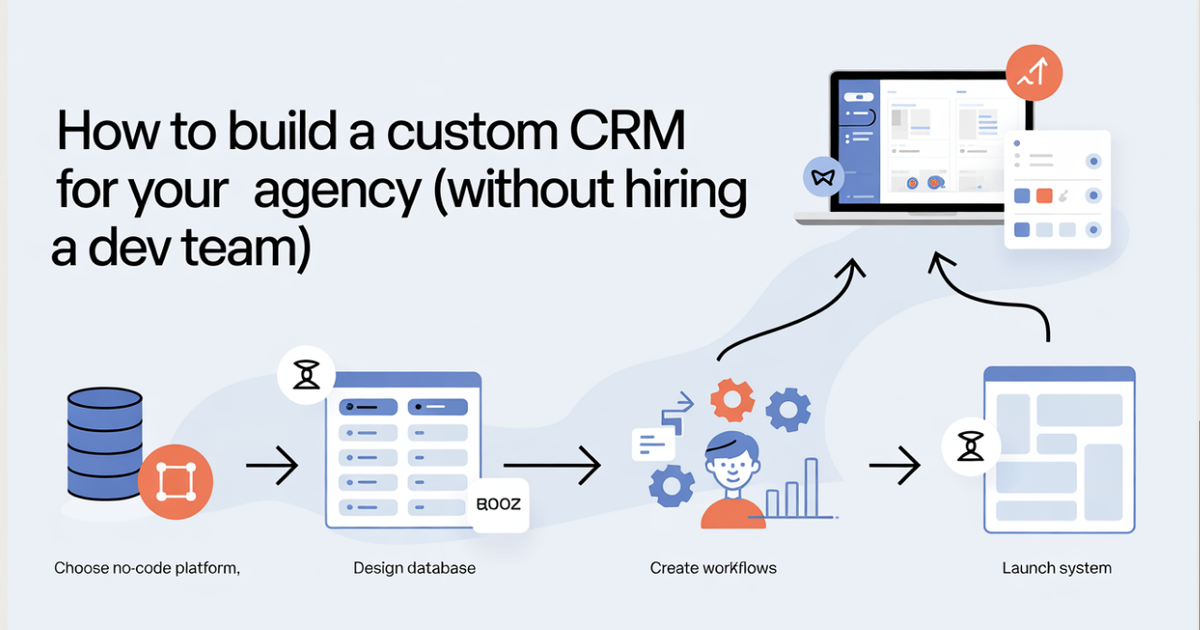
A custom agency CRM built by a development partner like DataStaqAI starts with a discovery process that maps your actual sales motion, not a generic one. The key deliverable from that process is a clear set of pipeline stages, field requirements, automation triggers, and reporting views that reflect how your agency already operates at its best.
The build itself typically takes four to six weeks for a core system: pipeline management, client records, renewal tracking, and basic reporting. Additional modules service expansion tracking, delivery health scoring, integrated reporting add time depending on complexity. The result is a system your team will actually use, because it's built around how they work rather than how a generic platform decided sales should work.
FAQ: What Agencies Ask Before Building a Custom CRM
Can't we just use GoHighLevel? Isn't that built for agencies?
GoHighLevel is primarily a marketing automation and client management platform with CRM features built around managing marketing campaigns for clients — not around running the agency's own new business and client retention pipeline. It's a strong tool for what it does. For managing your own sales pipeline, retainer renewals, and service expansion tracking, it has the same structural limitations as any generic platform: it wasn't built around your specific pipeline logic.
How do we migrate data from our current CRM?
A well-scoped build includes a data migration plan. If your current CRM has clean data, migration is straightforward. If the data is messy (which is true of most agency CRMs after a few years), the migration process is also a cleanup opportunity. A development partner builds the import logic as part of the project — you don't need to do this manually.
What if our pipeline process changes as we grow?
The key insight behind successful CRM implementations is that a CRM should rise to meet your people — not force them to completely rework how they operate to fit the system. DatastiQ A custom CRM is inherently more adaptable than a configured generic platform, because you own the data model. Adding a pipeline stage, changing field logic, or introducing a new automation doesn't require navigating vendor constraints or paying for a higher pricing tier. It requires a development conversation and a change to your system.
How much does a custom agency CRM cost to maintain?
Day-to-day operation requires no development input , your team uses it like any other tool. Structural changes, new integrations, or additional modules require development time, typically billed on a project basis. Most agencies find that the annual maintenance cost of a custom CRM is lower than the combined cost of the generic CRM subscription plus the operations time spent maintaining workarounds.
The CRM Your Agency Actually Uses Is Better Than the One It Doesn't
The most expensive CRM isn't the one you build. It's the one you've been paying for for three years that half your team ignores because it doesn't match how they work.
Generic CRMs fail agencies not because they're bad tools but because they're wrong-shaped tools. They were designed for a different sales motion, a different renewal model, and a different relationship structure than the one your agency runs on.
A custom agency CRM solves the adoption problem at the root — by being built around your actual workflows rather than asking your team to adapt their workflows to someone else's data model. That's not a luxury for large agencies. It's a practical choice for any agency that's outgrown the workarounds.
Book a free discovery call with DataStaqAI and we'll map out what a custom CRM for your specific agency pipeline would look like. No generic templates. No configuration workshops. Just a system built for how your agency actually sells and retains clients.