
How Long Does It Take to Build a Custom Internal Tool for Your Agency in 2026?
If you run a marketing, lead generation, creative, or consulting agency, you already know the operational drag that comes from scattered tools and manual processes. Once you decide a custom internal tool makes sense, the next question is almost always about time: how long will this actually take?
The short answer, based on 2026 industry benchmarks for internal business tools and agency-focused systems, is that most custom internal tools launch in 4 to 16 weeks from signed scope to live use. Simpler focused tools often land at the shorter end, while multi-feature systems with integrations extend toward the longer side.
If you have not yet reviewed typical costs, check our guide on how much it costs to build a custom internal tool for your agency in 2026. Understanding both cost and timeline together helps set realistic expectations.
What Actually Drives the Timeline
The biggest variable is not the coding itself. It is the upfront work and the complexity of connecting everything cleanly. Industry reports consistently show that discovery and data preparation take a significant portion of total time.
For example, projects with clean APIs and well-organized data move quicker, while those relying on scattered spreadsheets, email threads, or legacy systems without easy exports require extra steps for cleaning and migration.
Typical Timelines by Project Type in 2026
Here is a breakdown informed by recent benchmarks for internal tools:
- Focused single-purpose tool (for example, a reporting dashboard pulling from a few ad platforms or a structured client intake form): 4 to 8 weeks. These solve one core friction point and require fewer integrations.
- Multi-feature system (such as a client portal with real-time visibility combined with basic automation or lead tracking): 8 to 16 weeks. This range covers most agency needs once you have outgrown generic solutions.
- Comprehensive platform (multiple workflows connected with advanced logic): 16 weeks or longer. These are less common for mid-sized agencies and usually reserved for larger-scale operations.
These ranges assume a clear scope is locked in after discovery. Data from 2026 development guides places most internal tools for service businesses in the 6-to-12-week window when requirements are well defined.
Breakdown of the Build Phases
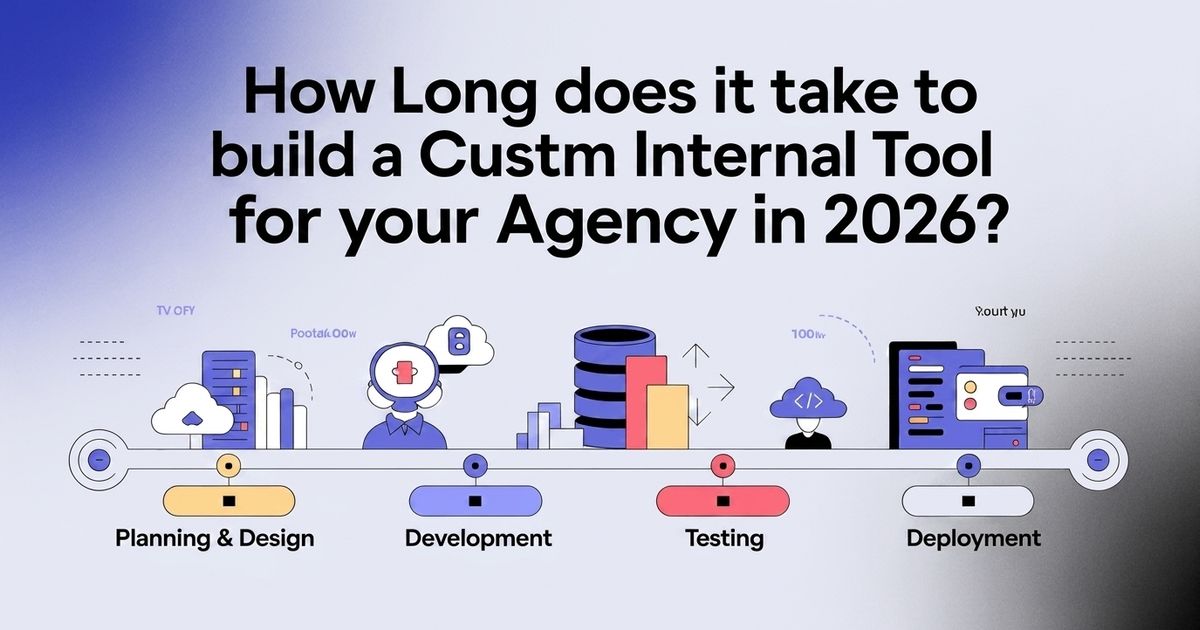
A typical custom internal tool project follows these phases, with approximate time allocations based on standard development reports:
- Discovery and planning (10-20 percent of total time): 1 to 3 weeks. This is where workflows are mapped, bottlenecks are identified, and the exact features are decided. Skipping or rushing this step often leads to later rework.
- Design and architecture (10-15 percent): 1 to 2 weeks. Interfaces, data flows, and integration points are planned.
- Development and integration (40-50 percent): The largest block. This is where the tool is actually built and connected to your existing systems.
- Testing, training, and launch (15-25 percent): 1 to 3 weeks. Real-data testing, user feedback rounds, and basic handover ensure the tool works reliably before full team use.
Ongoing maintenance after launch is usually handled separately through a support agreement and is not part of the initial build timeline.
What Decides the Timeline
Several factors push projects toward the shorter or longer end of the ranges:
- Clarity of requirements at the start: Well-documented processes and prioritized features reduce back-and-forth.
- Number and complexity of integrations: Connecting to advertising platforms, CRMs, or accounting tools adds time, especially if APIs are limited or undocumented.
- Data readiness: Clean, accessible data shortens the project. Scattered or inconsistent information across spreadsheets and emails extends the migration phase.
- Scope changes during development: Adding new features mid-build is one of the most common causes of delays.
- Team availability for feedback: Quick responses during review rounds keep momentum.
Benchmarks show that scope creep can extend timelines by weeks or more, which is why many agencies benefit from locking the initial scope after discovery.
Alternatives and How They Compare on Time
Custom development is not the only path. Here is how the main options line up in 2026:
- No-code or low-code platforms: These can deliver basic dashboards or simple tools in days to a few weeks. They work well for straightforward needs but may require workarounds as your agency scales or needs deeper customization.
- Off-the-shelf SaaS tools: Setup can happen in hours or days, but adapting them to your exact workflow often leads to ongoing manual processes that add hidden time costs over months.
- Hiring an in-house developer: This approach rarely produces a working tool faster than 3 to 6 months when you factor in onboarding and business context learning. It also involves ongoing salary costs regardless of new feature needs.
Custom builds sit in the middle: longer upfront than no-code but faster to deliver lasting value than fragmented workarounds or extended in-house development.
Red Flags When Getting Quotes from Development Partners
Watch for these signals that a proposed timeline may not hold up:
- A quote with no discovery phase or after only a short call without reviewing your current systems.
- Vague timelines without week-by-week milestones or clear deliverables.
- Extremely short timelines for anything beyond the simplest dashboard (under 4 weeks for most multi-feature agency tools is rare in custom coding).
- No discussion of post-launch support, training, or how updates will be handled.
Clear communication about scoping and data review upfront leads to more accurate timelines.
How to Get a Useful Timeline Estimate
To receive a realistic range quickly:
- List every step in the process you want to improve.
- Note every system where your data currently lives, including spreadsheets and manual steps.
- Identify who will use the tool and what access or actions each person needs.
Bring this information to a discovery discussion. Most professional teams can provide a clear timeline range within a day or two once they see your actual setup. At DataStaq AI we specialize in custom internal tools for service agencies.
We focus on practical scoping conversations early so timelines stay predictable and aligned with agency operations like client reporting, onboarding, and proposal workflows.
Start Small to Move Faster
The agencies that see results soonest often begin with one high-impact process rather than trying to solve everything at once. A focused tool that addresses your biggest daily friction can launch in the shorter timeline range and deliver measurable efficiency gains before expanding.
If you are evaluating options, the best next step is to map your current main bottlenecks and compare realistic timelines across approaches. Ready to get a timeline specific to your agency?
Book a free 30-minute strategy call. We will review your current workflows based on what you describe and provide a transparent scope and timeline estimate with no obligation.
This conversation helps many agency owners clarify priorities even if they decide to explore other solutions first.
Frequently Asked Questions
What is the fastest realistic timeline for a custom agency internal tool?
Focused tools with limited integrations can launch in 4 to 8 weeks when scope is clear and data is well organized.
Does building a client portal take longer than an internal dashboard?
Basic client portals typically require 8 to 12 weeks, while internal-only dashboards often fall in the 4-to-8-week range due to simpler access and security needs.
How do integrations affect the build time?
Each additional system connection adds time for setup, testing, and data syncing. Clean APIs keep this manageable; limited or legacy systems extend it.
What causes most timeline delays in custom projects?
Unclear requirements at the start and scope changes during development are the leading factors according to development benchmarks.
Can AI features extend the timeline?
Yes, adding AI elements such as automated summarization or generation logic requires extra planning and testing, which can add 1 to 3 weeks depending on complexity.