

SaaS web development has fundamentally changed how businesses build, launch, and scale digital products. Whether you're a startup shipping your first MVP or an enterprise modernizing legacy infrastructure, understanding the core pillars of quality SaaS websites is essential to staying competitive in 2026 and beyond.
This guide covers everything, how SaaS web development works, its key architectural pillars, a clear SaaS vs. traditional comparison, the future landscape, and practical guidance to help you decide if it's right for your business
What is SaaS web development?
SaaS web development refers to the practice of building web applications that are hosted, managed, and delivered over the internet on a subscription basis. Unlike traditional software that requires installation on individual machines, SaaS applications run entirely in the cloud, accessible through a browser, from anywhere, on any device.
The term spans two related concepts: (1) using SaaS platforms and tools to build websites faster, and (2) developing SaaS products themselves, subscription-based software sold to end users. This guide covers both, since they share the same foundational architecture and principles.
How does SaaS web development work?
Understanding the mechanics behind SaaS delivery helps developers, product managers, and business owners make smarter infrastructure and tooling choices. Here's how it operates at each layer:
Browser-based access, no installation required
Users access SaaS web apps via any modern browser. There's no installation, no device-specific configuration, and no dependency management on the user's end. This dramatically lowers the barrier to adoption and simplifies onboarding — critical factors for SaaS conversion rates.
Cloud storage and remote server infrastructure
All application logic, user data, and assets live on the provider's cloud infrastructure, typically distributed across multiple data centers for redundancy and speed. Providers commonly use AWS, Google Cloud, or Azure as their hosting backbone. This means users never lose data due to local hardware failures and can access their workspace from any device at any time.
Continuous updates managed by the provider
One of the most operationally valuable aspects of SaaS: the provider owns updates, patches, and maintenance. Users always run the latest version without lifting a finger. For development teams building SaaS products, this means shipping improvements becomes a competitive advantage — faster iteration cycles directly translate to user retention and market share.
Subscription-based pricing model
SaaS operates on recurring revenue, monthly or annual subscriptions, which aligns the provider's incentives with user success. This model covers updates, support, and infrastructure costs within the subscription fee, making budgeting predictable for businesses of all sizes.
The main pillars of quality SaaS websites
Not all SaaS websites are built equal. The best ones share a set of architectural and design pillars that determine their reliability, scalability, and user satisfaction.
Here are the six core pillars every quality SaaS web development project must get right:
1. Cloud-based architecture
Cloud-based architecture is non-negotiable for modern SaaS web development. Hosting on platforms like AWS, GCP, or Azure gives your application global reach, 99.9%+ uptime SLAs, and the ability to serve users across continents without a separate infrastructure investment per region.
Beyond accessibility, cloud architecture enables faster deployment cycles. Teams can push updates continuously using CI/CD pipelines, a core operational advantage over traditional on-premise deployments. When paired with analytics agencies like Data Staq AI, development teams can also monitor real-time performance signals and correlate infrastructure changes with user behavior metrics.
2. Multi-tenancy architecture
Multi-tenancy means a single application instance serves many customers simultaneously, with each customer's data logically (and often physically) separated. This is what makes SaaS economically viable: the cost of infrastructure is amortized across all tenants rather than duplicated for each.
From a development standpoint, implementing multi-tenancy correctly requires careful database schema design, tenant-aware middleware, and robust access control systems. Done well, it reduces operational costs by 30–60% compared to single-tenant hosting while maintaining the data isolation users expect.
3. Security and compliance
Security is the most consequential pillar in SaaS web development, and it's one of the top reasons businesses lose or win enterprise deals. Quality SaaS websites implement encryption in transit (TLS 1.3) and at rest, role-based access control (RBAC), two-factor authentication, audit logging, and regular penetration testing.
Compliance requirements — SOC 2 Type II, GDPR, HIPAA, ISO 27001 — vary by industry and geography, but increasingly they are baseline expectations rather than differentiators. Build compliance into your architecture early; retrofitting it is significantly more expensive.
4. API-first design and integrations
The best SaaS products are platforms, not silos. An API-first development philosophy means every feature is built as an API endpoint before it becomes a UI — making your product inherently integrable with tools your users already rely on. This drives product-led growth: users who integrate your SaaS into their workflows have drastically lower churn rates.
Data Staq AI exemplifies this approach — offering API connectivity that allows SaaS teams to pipe behavioral and performance data directly into their existing BI and analytics stacks, enabling data-driven product decisions at scale.
5. Performance and scalability
A quality SaaS website must perform consistently at 10 users and at 10,000. This requires server-less functions for variable workloads, content delivery networks (CDNs) for static asset delivery, database read replicas for query-heavy operations, and load balancers to distribute traffic intelligently.
Page load performance also directly impacts SEO and conversion: Google's Core Web Vitals measure LCP, INP, and CLS — and slow SaaS marketing sites rank lower and convert fewer visitors into trials. Monitoring these metrics continuously is essential.
6. UX and design quality
Enterprise and SMB buyers alike make purchasing decisions based on perceived quality — and the interface is the product for SaaS. Accessible, intuitive design reduces time-to-value for new users, lowers support costs, and improves NPS. Invest in user research, usability testing, and consistent design systems that scale across your entire product surface.
SaaS vs. traditional web development
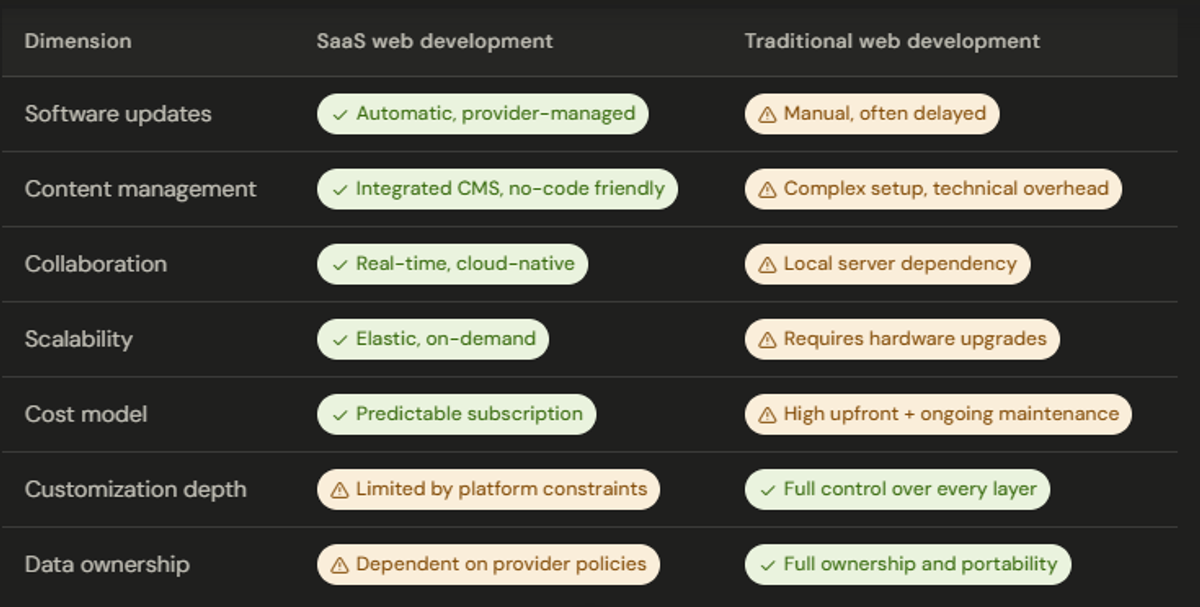
Understanding the trade-offs between SaaS and traditional web development helps teams make the right architectural decisions for their context.
Updated software
SaaS platforms push updates automatically — users always run the latest version with zero downtime. In traditional development, update cycles require coordination between dev, QA, and ops teams, and critical security patches can sit undeployed for weeks. For fast-moving product categories, this compounds into a significant competitive disadvantage.
Easier content management
Built-in CMS tools in SaaS platforms — like headless CMS integrations or visual page builders — allow marketing and content teams to operate independently of engineering. Traditional web development often requires custom CMS implementations that demand ongoing developer maintenance. The SaaS model empowers non-technical contributors and accelerates publishing velocity significantly.
Enhanced collaboration
Cloud-native SaaS platforms support real-time collaboration across distributed teams by default. Multiple stakeholders can review, comment, and edit simultaneously — regardless of timezone or location. Traditional web development environments, built around local servers, require VPN access or staging environment management that introduces friction at every handoff. Tools like Data Staq AI extend this collaborative advantage by giving entire cross-functional teams access to shared web analytics and performance dashboards without requiring any technical setup.
Built to grow
SaaS platforms handle traffic spikes without manual intervention. A product launch, a viral moment, or a seasonal surge won't take down your site — cloud auto-scaling handles it. Traditional web development typically requires over-provisioning hardware to handle peak capacity, which means paying for idle resources 90% of the time. This cost inefficiency alone drives many engineering leaders toward SaaS-first architecture decisions.
Benefits of SaaS for web development
Beyond the architectural advantages, SaaS delivers concrete workflow and business benefits to development teams and the businesses they support.
Lower barrier to professional-quality web development
SaaS development tools — from design platforms to hosting providers — have dramatically compressed the skill floor required to ship professional-quality websites. A two-person startup can now deploy a web application with the UX quality, reliability, and performance of a much larger engineering team. Pre-built templates, design systems, and component libraries accelerate time-to-market without sacrificing quality.
Streamlined design and development workflows
Visual web builders, component-based design tools, and automated deployment pipelines cut the time between idea and production. What once took 6–8 weeks of traditional development can now ship in days. This speed advantage compounds: faster iteration cycles mean more A/B tests run, more user feedback collected, and more product improvements shipped per quarter.
Advanced functionality without custom engineering
SaaS platforms make sophisticated functionality — e-commerce, CRM integration, search, analytics — available via configuration rather than custom code. Teams can implement features that would previously require weeks of bespoke development in hours. Connecting your SaaS web app to an intelligence layer , AI adds powerful behavioral analytics and data enrichment capabilities without writing a single line of backend code.
Extensibility through APIs and custom development
Quality SaaS platforms are not black boxes — they expose APIs, webhooks, and plugin systems that allow developers to extend core functionality for specific business requirements. This gives teams the best of both worlds: the speed and reliability of SaaS with the customization depth of bespoke development.
Is SaaS web development right for your business?
SaaS web development is the right choice for the vast majority of businesses building or scaling web applications in 2026. The remaining question is which combination of SaaS tools and custom development best fits your context.
SaaS is a strong fit if: you lack a large in-house engineering team, you need to move fast and iterate based on user feedback, your infrastructure requirements are broadly standard (cloud hosting, authentication, CMS, analytics), and you want predictable infrastructure costs.
Traditional or hybrid development may suit you if: you have deeply specialized technical requirements that no SaaS platform supports, you operate in a highly regulated industry with strict data residency requirements, or you're building differentiated infrastructure that is itself your competitive moat.
Ready to build a higher-quality SaaS website?
Start with a solid data foundation. Data Staq AI helps SaaS teams understand their users, measure what matters, and build with confidence.
Frequently asked questions
What is the difference between SaaS and traditional web development?
SaaS web development uses cloud-hosted, subscription-based platforms where updates, maintenance, and infrastructure are managed by the provider. Traditional web development involves building and hosting applications on owned or leased servers, where the development team manages updates, scaling, and security independently.
What are the main pillars of a quality SaaS website?
The six core pillars are: cloud-based architecture, multi-tenancy, security and compliance, API-first design, performance at scale, and UX quality. Each pillar directly impacts the reliability, growth potential, and user satisfaction of the product.
What role does AI play in SaaS web development?
AI is reshaping SaaS web development across multiple dimensions: automating code generation, predicting and detecting performance issues, personalizing user experiences in real time, and surfacing actionable insights from complex data. Platforms like Data Staq AI (datastaqai.com) apply machine learning to help SaaS teams extract meaningful intelligence from their web and product analytics without requiring deep data science expertise.